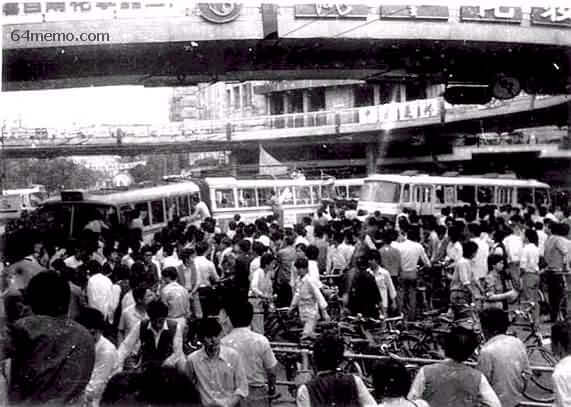
Following the news of the bloody crackdown in Tian'anmen Square on June 4, unrest intensified across the country. Major cities such as Hangzhou, Shanghai, Chengdu, Xi'an, and Wuhan were filled with the cry of the people. Sites of such protest were occasionally chaotic.
In Shanghai, college students and strikers gathered and set up roadblocks at dozens of traffic intersections in the city, in attempts to paralyze traffic. A "Ta Kung Pao" newspaper report from June 5th described it thus: "Angry crowds blocked traffic, and some chanted the slogan 'Oppose warlords'. In addition, abandoned buses parked on the road were turned into signboards, carrying the slogans 'Beijing has become a sea of blood', 'Blood of the people', and 'Blood! Blood! Blood!'"
In the face of mass protests, a Shanghai Municipal People's Government spokesperson issued a statement on the 5th: "We solemnly warn the tiny minority of planners, organizers, and leaders that your attempts to create turmoil in Shanghai do not have the hearts of the people, and will not succeed. If you are determined to go your own way and dare to test the law, you will bear full liability for all serious consequences that result."
The public's acts of destruction in various places remained dangerous, and innocent citizens were shot and injured. Nonetheless, according to "The Critical Moment – Li Peng Diaries", Jiang Zemin believed that the unrest in Beijing had been brought under control, and the crackdown on Tian'anmen Square had also had a great deterrent effect on rioters across the country. On the evening of the 5th, he called Shanghai Mayor Zhu Rongji, saying that he only needed to send a patrol unit of workers to maintain the order in the city. This is why the army wasn't dispatched to deal with the unrest in Shanghai.
References: [東方日報("Oriental Daily News")(Chinese)] (https://drive.google.com/file/d/1RxhfQqrdMqSL8nzr_lsLufMgwEmosYLm/view?usp=sharing); [大公報("Ta Kung Pao")(Chinese)] (https://drive.google.com/file/d/1TTPquT4l5nEMWYQMtb7ww5uldUwZZGXB/view?usp=sharing); "The Critical Moment – Li Peng Diaries" (https://drive.google.com/file/d/1vZUdNBJT3HjiqMnwkSF8ug7G864MGUZq/view?usp=sharing)