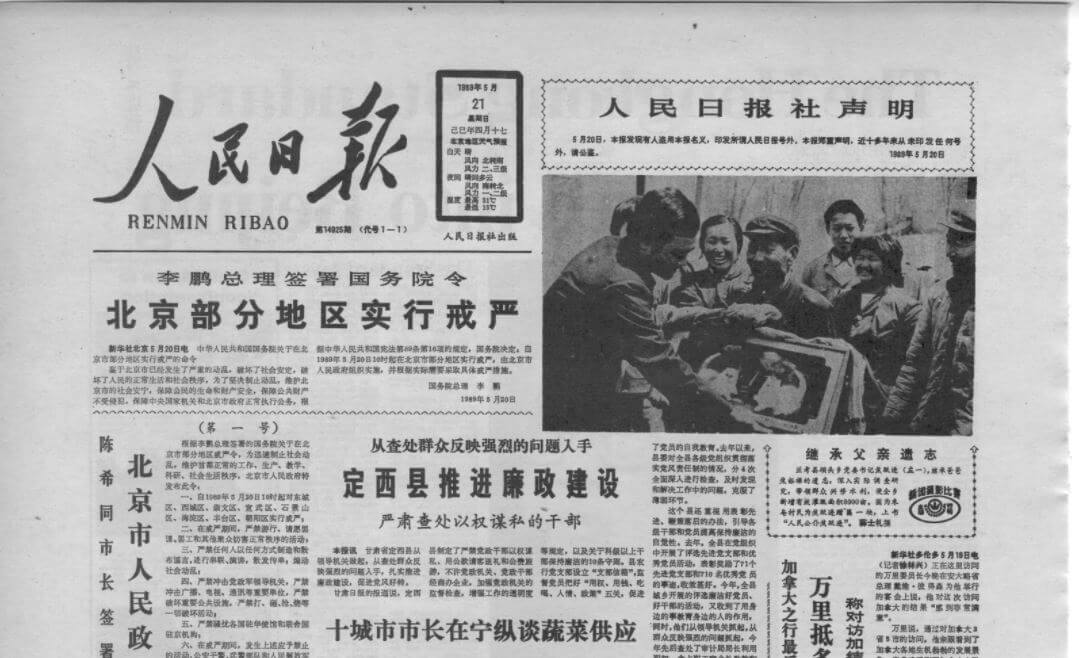
At 10:00pm on May 19th, the Chinese Communist Party (CCP) Central Committee held a meeting of party, government and military cadres in the capital, in a People's Liberation Army General Logistics Department auditorium. There, Li Peng delivered a speech announcing martial law in Beijing.
As recorded in "The Critical Moment – Li Peng Diaries", the leadership had held a meeting at Deng Xiaoping's house at 10:00 that morning. Li Peng recorded that some of the elders, three members of the Politburo Standing Committee, and three members of the Central Military Commission Standing Committee were present, along with three members (Chi Haotian, Zhao Nanqi, and Yang Baibing) from the People's Liberation Army (PLA)'s three headquarters units.
At 10:00pm on May 19th, the Central Committee held a meeting of party, government and military cadres in the capital in the auditorium of the General Logistics Department of the People's Liberation Army. Yang Shangkun, Li Peng, Qiao Shi, Hu Qili, Yao Yilin, and Wang Zhen sat on the rostrum, while Li Peng delivered a speech announcing martial law in Beijing.
That afternoon, Zhao Ziyang had received a notice asking him to preside over the meeting, at which he would deliver a speech at odds with his personal opinions. Later, in his book "Prisoner of the State: The Secret Journal of Premier Zhao Ziyang", Zhao wrote: "On the 17th, the decision to implement martial law was discussed at Deng's house. Although Li Peng, Yang Shangkun, and Qiao Shi were designated to be in charge, Deng still made a statement, saying that 'Zhao is still general secretary'. However, what happened a few days after the meeting actually put me completely on the sidelines." That night, he refused to attend the meeting, calling in sick. Li Peng criticized Zhao in his diary: "Zhao Ziyang refusing to attend such a crucial meeting once again exposes his break with the Central Committee, before the entire country and the world. Zhao Ziyang committed the unforgivable mistake of splitting the Party."
At the meeting, Li Ximing (Secretary of the CCP Beijing Committee) first explained how the student movement was developing. Li Peng then made a report, announcing that martial law be immediately be imposed in some areas of Beijing. He asked that the masses mobilize urgently, take a clear-cut stand to stop the turmoil, restore the normal social order, and maintain stability and unity. He also made two appeals: "1. To the students who are currently on hunger strike in Tian'anmen Square, we hope you will immediately stop the hunger strike, leave the Square, receive medical treatment, and return to health; 2. To the majority of students and the general public, we hope you will immediately stop all demonstrations and stop performing so-called 'acts of solidarity' with the hunger-striking students. To continue to engage in 'solidarity' is to push them along toward a dead end."
At the same time, the PLA's Martial Law Military Unit Command Post submitted a report to the Central Military Commission, Deng Xiaoping and Yang Shangkun. The report stated that the 27th, 38th, 39th and 63rd Group Armies of the advance force had arrived on time, in accordance with the Central Military Commission's orders. They had basically reached their destinations within Beijing city and were ready to implement martial law.
References: Zhang Wanshu, "The Big Bang of History: A Complete Record of the June 4th Incident"; Wang Dan, "The Memoirs of Wang Dan — From June 4th to Exile"; Feng Congde, "A Tiananmen Journal"; "The Critical Moment – Li Peng Diaries"; "The Tiananmen Papers"; "Prisoner of the State: The Secret Journal of Premier Zhao Ziyang"; Jeremy Brown, "June Fourth: The Tiananmen Protests and Beijing Massacre of 1989"; Wu Renhua, "Behind the Scenes of the June 4th Massacre: The Martial Law Forces of June 4th"