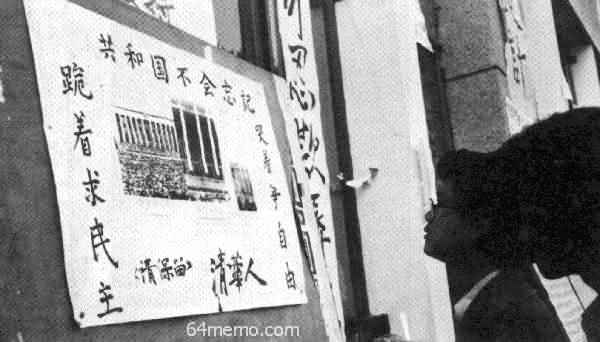
After the memorial service on April 22, there was a lot of indignation in the Square; a massive petition movement grew among the students. They asked that leaders at the venue accept the their Seven Demands and come forward to talk with the students. At 12:15pm, Guo Haifeng and Zhang Zhiyong from Peking University, and Zhou Yongjun from China University of Political Science and Law went up to the main entrance of the Great Hall of the People. Suddenly, they held aloft the petition and knelt on the steps. This caused a great uproar in the Square.
At the time, some students were quite critical of their kneeling; they believed kneeling demonstrated a feudal mindset and humiliated the students. Wu'er Kaixi and Feng Congde also shouted from the student contingents, "Don't kneel!" Time passed. After 35 minutes, no leader had come forward to meet them. Some students began to cry. Onlookers also sighed, "They have been kneeling for so long, why is no one paying them any attention?" "This is how afraid the officials are of the students!" With grief and indignation, Feng Congde would later write in "A Tiananmen Journal", "In a large nation of more than one billion people, how could it be that no sympathetic, righteous leader dared to stand up and face the people, to listen to their opinions and aspirations for the country? I really can't describe that air of grief, anger, and depression, but I can clearly and bitterly remember the infinite sadness that moment gave me. I felt that a nation was dying; and I was sad for myself, to find myself numbered within such a hopeless group…".
Afterwards, there was a wave of rioting in the Square. Friction between some of the crowds and the Armed Police resulted in pushing and shoving that lasted for about 15 minutes. At 1:50pm, the institutions of higher education began to leave in an organized manner. On the way back to their campuses, all shouted in one voice slogans to show their determination, such as "Let the the whole country know; class strikes without end" and "We will risk life and limb to speak for the people".
The memorial service was over, but the students' anger did not subside. Instead, it entered a new stage — class strikes. As Wang Dan wrote in his memoirs, "Most students didn't originally take an anti-government stance as they took to the streets. Not only did they not want to fight against the government, they also had no experience in fighting against the government… But once they truly were on the streets and suddenly found themselves faced with such treatment, their grievances turned into anger. They set upon the road of breaking off relations with the government."
References: Zhang Wanshu, "The Big Bang of History: A Complete Record of the June 4th Incident"; Wang Dan, "The Memoirs of Wang Dan — From June 4th to Exile"; Louisa Lim, "The People's Republic of Amnesia: Tiananmen Revisited"; Feng Congde, "A Tiananmen Journal"; "The Tiananmen Papers"